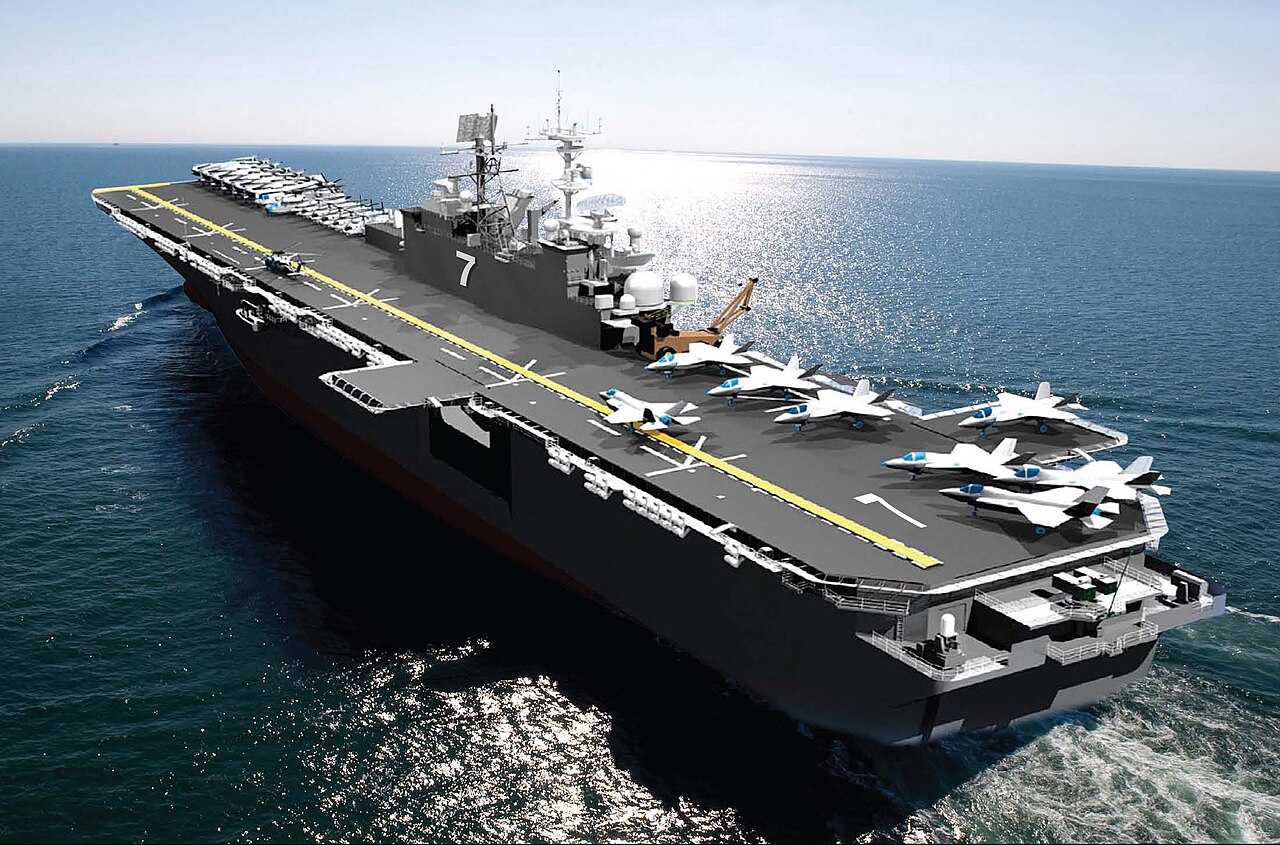
IRGC Claims Strike on USS Tripoli
Iran’s Islamic Revolutionary Guard Corps claimed at 14:30 UTC on April 6 that it struck the USS Tripoli (LHA-7), a US Navy amphibious assault ship carrying more than 5,000 troops. The IRGC said the vessel was pulled back toward the southern Indian Ocean. The United States has not confirmed the attack.
Iran’s IRGC claimed it struck the USS Tripoli, a Wasp-class amphibious assault ship, as part of the 98th wave of Operation True Promise 4 on Sunday. If confirmed, it would be the single most consequential Iranian strike against the US Navy since the war began on February 28. The Pentagon declined to comment. The Tripoli carries a Marine Expeditionary Unit with over 5,000 personnel and serves as a key platform for amphibious operations in the Gulf theater.
The IRGC also claimed strikes on an Israeli cargo vessel and a drone attack on the MSC Ishika container ship in the Strait of Hormuz. Neither claim could be independently verified at the time of publication.
What did Trump threaten over Hormuz?
President Donald Trump delivered his most explicit ultimatum of the war on Sunday, demanding Iran reopen the Strait of Hormuz by Tuesday at 8:00 PM Eastern Time. He made the threat in characteristically blunt terms.
Open the f***ing Strait, you crazy bastards, or you will live in hell!
Trump said he would order strikes on Iranian bridges and power plants if the deadline passes without compliance. Roughly 20% of the world’s traded oil moves through the Strait of Hormuz. The waterway has been effectively closed or severely disrupted since early March, when Iran mined key shipping lanes and deployed anti-ship missile batteries along its coastline.
This is not Trump’s first Hormuz deadline. He issued a 48-hour ultimatum on March 22 and extended it on March 26. Both passed without military action against civilian infrastructure.
Why did Iran reject the ceasefire?
Tehran dismissed a temporary ceasefire proposal and submitted a 10-point counterdemand list that went far beyond the scope of any previous negotiation. The demands included:
- A permanent end to hostilities on all fronts, including Gaza and Lebanon
- Removal of all US military bases from Gulf states
- Iranian control of the Strait of Hormuz with the right to charge transit fees
- Full lifting of all US and international sanctions
- Recognition of Iran’s right to peaceful nuclear enrichment
- Reparations for war damage inflicted on Iranian territory
The remaining four points were not immediately made public. Western diplomats who reviewed the list described it as a nonstarter, according to Al Jazeera. The demands signal that Tehran sees no reason to negotiate from a position of weakness while its missile forces remain operational and Hormuz stays closed.
Who was Majid Khademij?
Mojtaba Khamenei, Iran’s Supreme Leader, confirmed on Sunday that Israel killed Majid Khademij, the commander of the IRGC’s intelligence service. Khademij is the highest-ranking Iranian intelligence official killed since the war began.
No details were released about when or how Khademij was killed. Israel has conducted targeted strikes against senior IRGC commanders throughout the conflict, but this is the first confirmed loss at the top of Iran’s intelligence apparatus. The killing follows a pattern of Israeli operations aimed at degrading Iran’s command structure, including strikes on missile program leadership and air defense coordinators in previous weeks.
What happened in Shiraz?
US warplanes struck multiple targets in and around Shiraz on Sunday, hitting ballistic missile production facilities, air defense installations, and drone operations centers, according to CENTCOM. Shiraz is home to several IRGC aerospace units and has been a repeated target since the war’s opening days.
The strikes are part of the ongoing American campaign to degrade Iran’s ability to produce and launch ballistic missiles. Iran has fired hundreds of missiles at targets across the Gulf since February 28, and the US has prioritized destroying launch infrastructure over territorial objectives.
How bad is the damage to UAE oil facilities?
Satellite imagery analyzed on April 6 confirmed fires burning at three major UAE oil facilities: Asab, Habshan, and Bu Hasa. All three are operated by ADNOC, the Abu Dhabi National Oil Company, and sit in the emirate’s western desert.
The fires followed Iranian strikes on Saturday as part of the IRGC’s ongoing Wave operations. The UAE has not released casualty figures or production impact estimates. Together, the three facilities account for a significant share of UAE oil processing capacity. Abu Dhabi produces roughly 3.2 million barrels per day.
The attacks on UAE soil mark a continued expansion of Iran’s target set beyond Israel and US military positions. Gulf states, which initially tried to stay out of the conflict, have been drawn deeper into the war with each wave of IRGC operations. Kuwait, Bahrain, and Saudi Arabia have all sustained strikes on energy infrastructure in recent weeks.
The Diplomatic Dead End
Day 38 of the war brought no sign of a path toward de-escalation. Iran’s 10-point list reads less like a negotiating position and more like a declaration of its war aims. Trump’s Tuesday deadline, if enforced, would mark the first deliberate US attack on Iranian civilian infrastructure, crossing a line both sides have so far avoided.
The Hormuz deadline expires Tuesday at 8:00 PM Eastern. Iran has shown no sign of complying.